
Automatización de Agua y Agua Cruda para el Proyecto de Energía Térmica Kalisindh 2×600 MW de RRVUNL
Actualizado: 31 mar
Un estudio de caso integral que demuestra excelencia en automatización de extremo a extremo en infraestructura crítica de agua para la generación de energía térmica.
Resumen del Proyecto
El Proyecto de Energía Térmica Kalisindh representa un hito significativo en la infraestructura de generación de energía para Rajasthan. Esta instalación de 2 × 600 MW requirió sistemas de automatización sofisticados para garantizar un suministro confiable de agua desde una fuente fluvial remota, presentando desafíos técnicos únicos que demandaron soluciones de ingeniería innovadoras y una integración fluida entre múltiples disciplinas.
Cliente y Ubicación
Usuario Final: Rajasthan Rajya Vidyut Utpadan Nigam Limited (RRVUNL)
Proyecto: Proyecto de Energía Térmica Kalisindh 2 × 600 MW
Ubicación: Distrito de Jhalawar, Rajasthan
Contratista Principal: Vaibhav Structurals
Socios Tecnológicos
Integrador del Sistema (I&C): CABISOL
Socio Tecnológico (Inalámbrico): Sheetal Wireless
Tipo de Proyecto: Paquete Llave en Mano de Instrumentación y Control
Segmento: Automatización de Infraestructura de Agua
Desafío Crítico: Control Remoto a 21 Kilómetros
El desafío principal del proyecto fue la extraordinaria distancia entre el punto de captación de agua del río y la instalación principal de la planta de energía. Ubicados aproximadamente a 21 kilómetros de distancia, esta separación geográfica creó importantes desafíos técnicos para el monitoreo y control en tiempo real.
Los métodos tradicionales de comunicación por cable no eran viables debido a la ausencia de infraestructura de fibra óptica en este terreno remoto, lo que hizo necesario implementar una solución inalámbrica innovadora capaz de mantener una transmisión de datos confiable e ininterrumpida.
Las tres bombas críticas instaladas cerca del río Kalisindh representaban la línea vital de todo el sistema de enfriamiento y procesamiento de la planta de energía. Cualquier falla en el monitoreo o control podría provocar interrupciones operativas catastróficas, con pérdidas potenciales de millones debido a la reducción en la capacidad de generación.
El cliente requería confianza absoluta en que el sistema de automatización funcionaría de manera impecable en todas las condiciones, con visibilidad en tiempo real del estado de las bombas, los parámetros de flujo y los indicadores de salud del sistema desde la sala de control central.
Desafío de Distancia
21 km de separación entre la toma de agua del río y la planta
No existía infraestructura de fibra óptica
Terreno desafiante para la instalación de cableado
Se requería una solución de comunicación inalámbrica
Requisitos de Confiabilidad
Suministro de agua crítico para una capacidad de 1.200 MW
Tolerancia cero a fallos de comunicación
Monitoreo y control en tiempo real esenciales
Sistemas redundantes para una operación segura ante fallos
Complejidad de Integración
Múltiples proveedores y sistemas que requerían coordinación
Integración de instrumentación de campo
Programación de PLC y desarrollo de lógica
Implementación del sistema SCADA
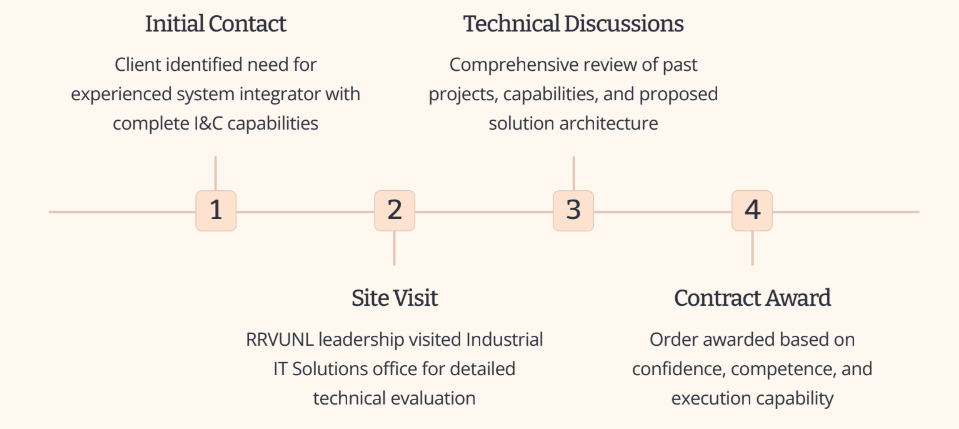
Por qué se seleccionó a CABISOL
The selection process for this critical infrastructure project was rigorous and comprehensive. RRVUNL's decision to award the contract to CABISOL was based on multiple factors that extended beyond competitive pricing. The client's leadership personally visited CABISOL office to evaluate their technical capabilities, review past project documentation, and assess the team's expertise in handling complex automation challenges.
What distinguished CABISOL from competitors was their ability to offer single-point responsibility for the entire Instrumentation, Automation, and Communication scope. Rather than coordinating with multiple specialized vendors, the client found a partner capable of managing all aspects of the I&C package. This integrated approach significantly reduced project complexity, minimized coordination risks, and ensured clear accountability throughout the execution phase.
The company's proven track record in power plant automation, particularly in water management systems, provided the confidence necessary for such a mission-critical application. Their demonstrated competence in similar projects, combined with a comprehensive understanding of the unique challenges posed by the 21-kilometer wireless communication requirement, made them the natural choice for this ambitious undertaking.
Comprehensive Scope of Work
CABISOL executed the complete Instrumentation & Control package on a turnkey basis, encompassing every aspect of the water automation system from field-level instrumentation to centralized SCADA visualization. The scope was strategically divided into four interconnected work packages, each requiring specialized expertise and seamless integration with the others.
Pump Station Automation
Complete automation of three raw water pumps at the river-side location, including field
instrumentation integration for pressure, flow, level, and status signals. PLC-based control
logic implemented pump operation sequences, safety interlocks, and local control panels for field operation and maintenance access.
Raw Water Control System
Centralized automation architecture for both river water pumping and raw water transfer to
the power plant. The system incorporated sophisticated alarm management, comprehensive event logging, and safe pump sequencing protocols to ensure reliable operation under all conditions.
Wireless Communication
Engineered and commissioned a robust long- distance wireless communication system
spanning approximately 21 kilometers between the river pumping station and main
plant control room. The system enables reliable real-time data transfer for pump
status, flow and pressure parameters, alarms, and control commands.
SCADA Integration
Developed and deployed a comprehensive SCADA system providing centralized monitoring and control. Real-time visualization of all pumps and water parameters, with seamless integration of field PLCs with plant- side SCADA infrastructure for unified operational visibility.
Technical Architecture & System Design
The system architecture was designed with redundancy and reliability as paramount objectives. At the heart of the solution was a distributed control philosophy that leveraged programmable logic controllers (PLCs) at the remote pump station for autonomous operation, while maintaining continuous communication with the central SCADA system for monitoring and supervisory control. This approach ensured that even in the unlikely event of communication disruption, the pumps could continue operating safely based on pre-programmed logic and local instrumentation feedback. The wireless communication backbone utilized industrial-grade radio equipment specifically engineered for mission-critical applications. Working in close coordination with technology partner Sheetal Wireless,
CABISOL configured a licensed wireless architecture that provided the bandwidth, latency, and reliability required for real-time control applications. The communication system was thoroughly tested under various environmental conditions to ensure consistent performance during monsoons, extreme heat, and other challenging weather scenarios typical of the Rajasthan region. Field instrumentation was carefully selected and integrated to provide comprehensive visibility into system performance. Pressure transmitters monitored pump discharge and pipeline conditions, electromagnetic
flow meters tracked water flow rates with high accuracy, level sensors ensured proper suction conditions, and digital status inputs confirmed pump running states and valve positions. All instrumentation signals were processed by the field PLCs and transmitted to the central SCADA system for operator interface and historical data logging.
Field Instrumentation
Pressure, flow, level sensors integrated with pump controls
PLC Control Logic
Autonomous pump operation with safety interlocks
Wireless System
21 km industrial-grade communication backbone
Central SCADA
Real-time monitoring and supervisory control
Challenges Overcome Through Innovation
Every major infrastructure project encounters obstacles, and the Kalisindh automation system was no exception. However, the systematic approach employed by CABISOL transformed these challenges into opportunities to demonstrate technical excellence and problem-solving capability. The table below illustrates how specific challenges were addressed through innovative engineering solutions and collaborative execution.

The successful resolution of these challenges required not only technical expertise but also effective project management, clear communication with all stakeholders, and an unwavering commitment to quality and reliability. The team's ability to anticipate potential issues and implement proactive solutions proved instrumental in delivering the project on schedule and within budget.
Project Execution Excellence
The execution phase of the Kalisindh project exemplified CABISOL methodical approach to complex system integration. The project team established a comprehensive execution plan that balanced parallel workstreams with critical path dependencies, ensuring maximum efficiency without compromising quality or safety standards. Regular coordination meetings with Vaibhav Structurals, Sheetal Wireless, and RRVUNL representatives ensured alignment on progress, technical decisions, and schedule adherence. Factory acceptance testing (FAT) played a crucial role in de-risking the site commissioning phase. All control
panels, PLC programs, and SCADA interfaces were thoroughly tested at CABISOL facility before shipment to site. This approach allowed the team to identify and resolve issues in a controlled environment, significantly reducing troubleshooting time during field commissioning. The wireless communication system underwent extensive range testing and performance validation to confirm signal strength and data integrity over the 21-kilometer link. Site installation and commissioning were executed with minimal disruption to the ongoing civil and mechanical works. The team coordinated closely with other contractors to optimize access to work areas and ensure safety protocols were maintained at all times. Loop checks verified the integrity of all instrumentation circuits, and systematic functional testing confirmed proper operation of all control sequences and safety interlocks before the system was energized with live process conditions.
Engineering & Design
Detailed system architecture, PLC programming, SCADA development, and comprehensive documentation
Factory Acceptance Testing
Complete testing of panels, control logic, and communication systems in controlled
environment
Site Installation
Panel installation, instrumentation mounting, cable pulling, and termination with quality inspections
Commissioning & Testing
Loop checks, functional testing, wireless system validation, and integrated system performance verification
Handover & Training
Operator training, documentation handover, and successful system stabilization within committed timelines
The successful commissioning without major shutdowns or operational disruptions demonstrated the effectiveness of the planning and execution strategy. The system was stabilized and formally handed over to RRVUNL operations within the committed project timelines, meeting all performance guarantees and client expectations.
Measurable Results & Client Benefits
The completed River Water & Raw Water Automation System has delivered substantial operational and strategic benefits to RRVUNL's Kalisindh Thermal Power Project. Since commissioning, the system has maintained consistent, reliable performance, ensuring uninterrupted water supply to both 600 MW generating units. The real-time monitoring and control capabilities have transformed operational efficiency, enabling operators to respond immediately to changing conditions and optimize pump operation based on actual plant
demands.

Operational Excellence
Remote monitoring and control of river pumps from plant control room eliminated the need for continuous field presence, reducing operational risk and improving response time to abnormal conditions.
Enhanced Reliability
Uninterrupted raw water supply to both generating units through redundant control logic,
fail-safe design, and comprehensive alarm management systems.
Improved Efficiency
Optimized pump operation based on real-time plant demands, reduced manual intervention,
and faster troubleshooting through comprehensive diagnostic capabilities.
Client Satisfaction
High client satisfaction achieved through smooth execution, professional project management, and system reliability that exceeded performance guarantees.
Establishing Leadership in Water Segment Automation
The successful execution of the Kalisindh River Water & Raw Water Automation Project serves as compelling evidence of CABISOL capabilities in water infrastructure automation for large-scale power generation facilities. This benchmark project demonstrates comprehensive competencies that extend across the entire project lifecycle, from initial
engineering and system design through commissioning and performance optimization. The company's ability to manage complex, mission-critical automation systems positions them as a preferred partner for similar applications across the power and utilities sectors.
The project showcases several distinctive strengths that differentiate CABISOL in the competitive system integration market. As a trusted end-to-end system integrator, the company provides single-point accountability that simplifies project execution and reduces coordination risks for clients. Their proven expertise in complex water infrastructure automation, particularly in challenging applications involving long-distance communication and remote monitoring, addresses a critical need in the power generation industry where water management is essential to operational reliability. CABISOL experience with long-distance communication-based control systems represents a unique capability
that few competitors can match. The successful implementation of the 21-kilometer wireless system for real-time pump control demonstrates both technical sophistication and practical problem-solving ability. This expertise is directly applicable to numerous other applications in water treatment plants, raw water systems, cooling water systems, and distributed pump
stations where similar challenges exist. Beyond technical capabilities, the company's track record as a reliable partner throughout the complete project lifecycle from engineering through commissioning and beyond provides clients with confidence that their critical infrastructure will be delivered on time, within budget, and to the highest quality standards. The Kalisindh project stands as a powerful reference that can be confidently presented to prospective clients in power plants, water treatment facilities, raw water systems, and utilities seeking a proven partner for their automation needs.

"The Kalisindh River Water & Raw Water Automation Project stands as a strong reference showcasing Industrial IT Solutions' capability to deliver mission-critical water automation systems for large thermal power projects. This case study can be confidently presented as a benchmark project to establish CABISOL as a preferred partner in the Water Segment for Power Plants, Raw Water Systems, and Utilities."